Sustainable by Design
Extend device life. Reduce emissions. Enable a more circular IT future.
Casterly helps organizations transition from linear IT to circular models — through refurbishment, responsible disposition, and measurable ESG outcomes.
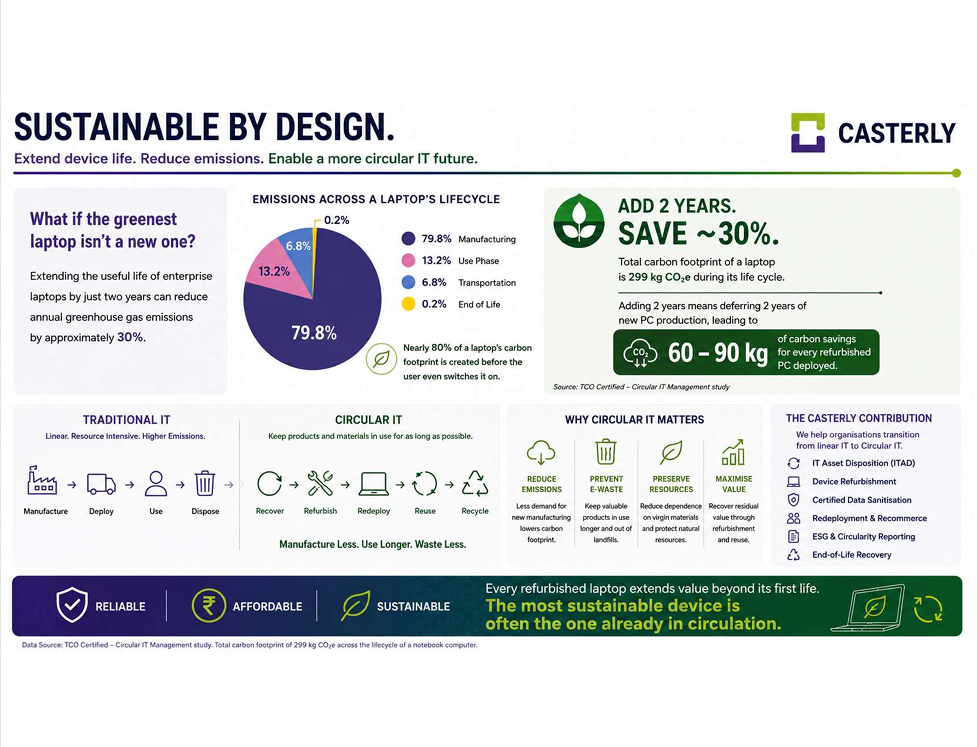
What if the greenest laptop isn't a new one? Extending the useful life of enterprise laptops by just two years can reduce annual greenhouse gas emissions by approximately 30%.
Circular IT
Extend value. Reduce waste. Keep devices productive.
Refurbishment, redeployment, and responsible recovery—connected to the same lifecycle intelligence that runs your estate.
Where laptop emissions come from
Nearly 80% of a laptop's carbon footprint is created before the user even switches it on.
- Manufacturing79.8%
- Use Phase13.2%
- Transportation6.8%
- End of Life0.2%
79.8%
Manufacturing
Add 2 Years. Save ~30%.
Total carbon footprint of a laptop is 299 kg CO₂e across its lifecycle. Adding 2 years of use means deferring 2 years of new PC production — leading to 60–90 kg of carbon savings for every refurbished PC deployed.
Source: TCO Certified – Circular IT Management study

Traditional IT vs. Circular IT
Traditional IT
Linear, resource-intensive, higher emissions
- Manufacture
- Deploy
- Use
- Dispose
Circular IT
Keep products and materials in use for as long as possible
- Recover
- Refurbish
- Redeploy
- Reuse
- Recycle
Manufacture less. Use longer. Waste less.
Why circular IT matters
Reduce Emissions
Less demand for new manufacturing lowers carbon footprint.
Prevent E-Waste
Keep valuable products in use longer and out of landfills.
Preserve Resources
Reduce dependence on virgin materials and protect natural resources.
Maximize Value
Recover residual value through refurbishment and reuse.
The Casterly Contribution
How we help organizations transition from linear to circular IT
- IT Asset Disposition (ITAD)
- Device Refurbishment
- Certified Data Sanitisation
- Redeployment & Recommerce
- ESG & Circularity Reporting
- End-of-Life Recovery
Every refurbished laptop extends value beyond its first life. The most sustainable device is often the one already in circulation.